
Money
How to Build a Paycheck-to-Paycheck Budget
TL;DR
- If you are paid weekly or every two weeks, a monthly budget often fails because bills do not land in a neat 30-day pile. Budget each paycheck instead.
- Write down take-home pay (not gross), every bill, and which payday will cover it. One bill should have one home.
- A 50/30/20 split can be a starting point, but your rent due date matters more than the percentages. Adjust until each paycheck can actually clear.
- Build a small buffer — even one leftover bill cycle — before you chase a perfect spreadsheet.
A budget built around a calendar month works best if you are paid once a month and your bills follow that rhythm. Many people are not. If you are paid every week or every two weeks, rent may land in one check, a car payment in the next, and a utility bill on a day that does not line up with either. The month looks fine on paper and still feels tight in the week a large bill hits. The fix is simple, though it takes a quiet hour: budget from paycheck to paycheck. This is a planning method, not personal financial advice. For broader tools and worksheets, the Consumer Financial Protection Bureau keeps public consumer guides on money management.
Start with take-home pay, not the gross amount
Use the amount that actually arrives in your account after taxes and other withholdings. If your hours change, use a conservative typical check, not your best week. Write the pay dates for the next four to six weeks. If you have two incomes, write both. If some of your pay is cash or a paper check, still write the amount and the day you usually have it in hand.
Then list every bill and regular cost, with due dates: rent or housing, utilities, phone, insurance, minimum debt payments, transportation, groceries, childcare, and any subscription you actually use. A “regular cost” is something that happens most months, even if the exact amount moves a little. Skip a hopefully-perfect number for groceries if a range is more honest; pick the higher end of that range for the first draft.
Give every bill a paycheck
Next to each bill, write which payday will pay it. The rule is that the money should be in the account before the due date, with a day or two of slack if a weekend or a bank delay could get in the way. Some bills will naturally attach to the first check of the month. Others belong to the second. If a bill is due right after payday, it still belongs to that check only if the money will clear in time.
Do not split a single bill across two paychecks unless you already have the first half set aside. Splitting “in your head” is how a due date sneaks up underfunded. If one paycheck cannot cover everything assigned to it, you have a timing problem, not just a spending problem. Move a flexible cost (groceries, fuel, a subscription) to the other check, or cut that check’s optional spending until the numbers work on paper.
Use percentages only as a starting point
A common starting split is 50 percent of take-home pay for needs, 30 percent for wants, and 20 percent for savings and extra debt payments. That framing is widely used as a teaching tool. It is not a law, and it will not fit every household. If housing alone takes more than half of a check, the percentages have to move. The paycheck assignment still comes first. Once each check can cover its bills, you can use a 50/30/20 view — or your own categories — to see where leftover money is going. The free paycheck budget calculator on this site can show both views.
Build a small buffer, then look again
The first goal is not a large emergency fund. It is one paycheck that is no longer spoken for the moment it arrives. Even a small leftover, kept in the same account or a separate “buffer” envelope, absorbs a bill that posts a day early or a week when work hours dip. The CFPB’s consumer tools include guidance on handling bills and debt; a buffer is often what makes those plans survivable week to week.
After two full pay cycles, compare the plan with what happened. If groceries ran over, raise the number rather than scolding the plan. If a bill was easier than you thought, you can free that money for a debt payment or a buffer. Change the assignments; do not throw the whole system out. A paycheck budget is working when you can say, before the week starts, which check will cover the next bill — and the answer is on a page, not only in your head.
When income is uneven
If your hours change from week to week, build the plan on a lower typical check, not an overtime week. When a larger check arrives, decide in advance where the extra goes — a buffer, a debt payment, or a bill you have been tempted to split. If you do not decide, the extra tends to disappear, and the next small check feels like a crisis all over again.
People who get a large portion of their income as a tip, a commission, or a seasonal bonus can still use a paycheck budget, but they need a baseline for the regular bills and a separate rule for the variable part. Pay the assigned bills from the baseline first. Treat the variable part as money you assign after it arrives, not money you spend in advance. The CFPB’s consumer tools are a good public place to keep reading if you want more on bills, credit, and debt. The method on this page stays useful only if it stays honest about the check you actually have.
Sources
Try a free tool: Paycheck Budget Calculator. Split a paycheck with a 50/30/20 plan or your own categories. See per-paycheck and monthly amounts, then print the result.
Optional
A template if you want one
Use these if you want a ready-made file. The guides and tools work without them.
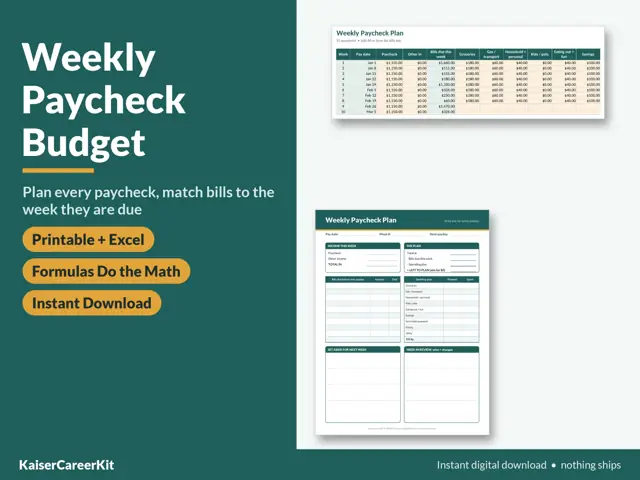
Weekly Paycheck Budget Planner
Weekly Paycheck Budget Planner: plan every paycheck, see which bills are due each pay week, and track sinking funds, debt payoff and savings.
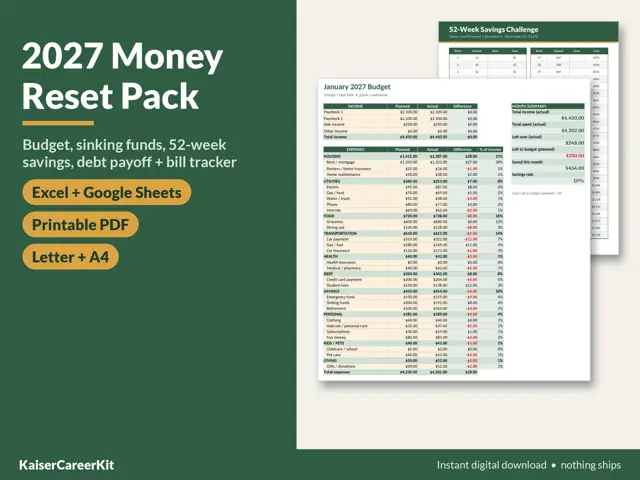
2027 Money Reset Pack
2027 New Year Money Reset Pack: monthly budget, sinking funds tracker, 52-week savings challenge, debt payoff tracker and bill tracker.
Money Bundle
Our money and business templates in one download. See the full contents list on the checkout page.
Also on Gumroad (opens in a new tab)
More like this
Money
Snowball vs. Avalanche: Pick a Debt Payoff Method
Compare the debt snowball and avalanche methods with your balances and APRs. Avalanche often costs less interest; snowball may be easier to finish.
Free printable
Get the free Christmas word search
Print a sample of our holiday word search puzzles for family game night, the classroom, or a quiet evening with coffee. Big, easy-to-read puzzles.
Free download, no purchase needed. The checkout page may ask for an email address to deliver the file.